
Your existing rating stays exactly as it is. A change of assessment framework does not expire, downgrade or invalidate a published rating. It stands until CQC next assesses your service and publishes a new one. The question that actually matters is not what the reform does to your rating — it is when you will next be assessed, and that is driven by how old your rating already is.
The question behind the question
This is the first thing providers ask about the 2026 reform, and it is usually the wrong worry. Ratings are not reissued when methodology changes. There is no re-baselining exercise, no bulk conversion, no expiry date attached to the old framework.
What changes is the basis on which your next rating is reached. So the useful question is: will that next assessment happen under the current framework or a new one?
Which framework will assess you
CQC's four draft sector frameworks were published 24 March 2026, are being piloted over summer 2026, and are expected to be implemented at the end of the year. The Single Assessment Framework remains in force until then.
That gives a fairly clean split:
| If your next assessment falls… | You will be assessed under… |
|---|---|
| Before implementation (i.e. during 2026) | The Single Assessment Framework — five key questions, 34 quality statements, six evidence categories, scoring |
| After implementation | Your sector's new framework — key lines of enquiry, rating characteristics, no scoring |
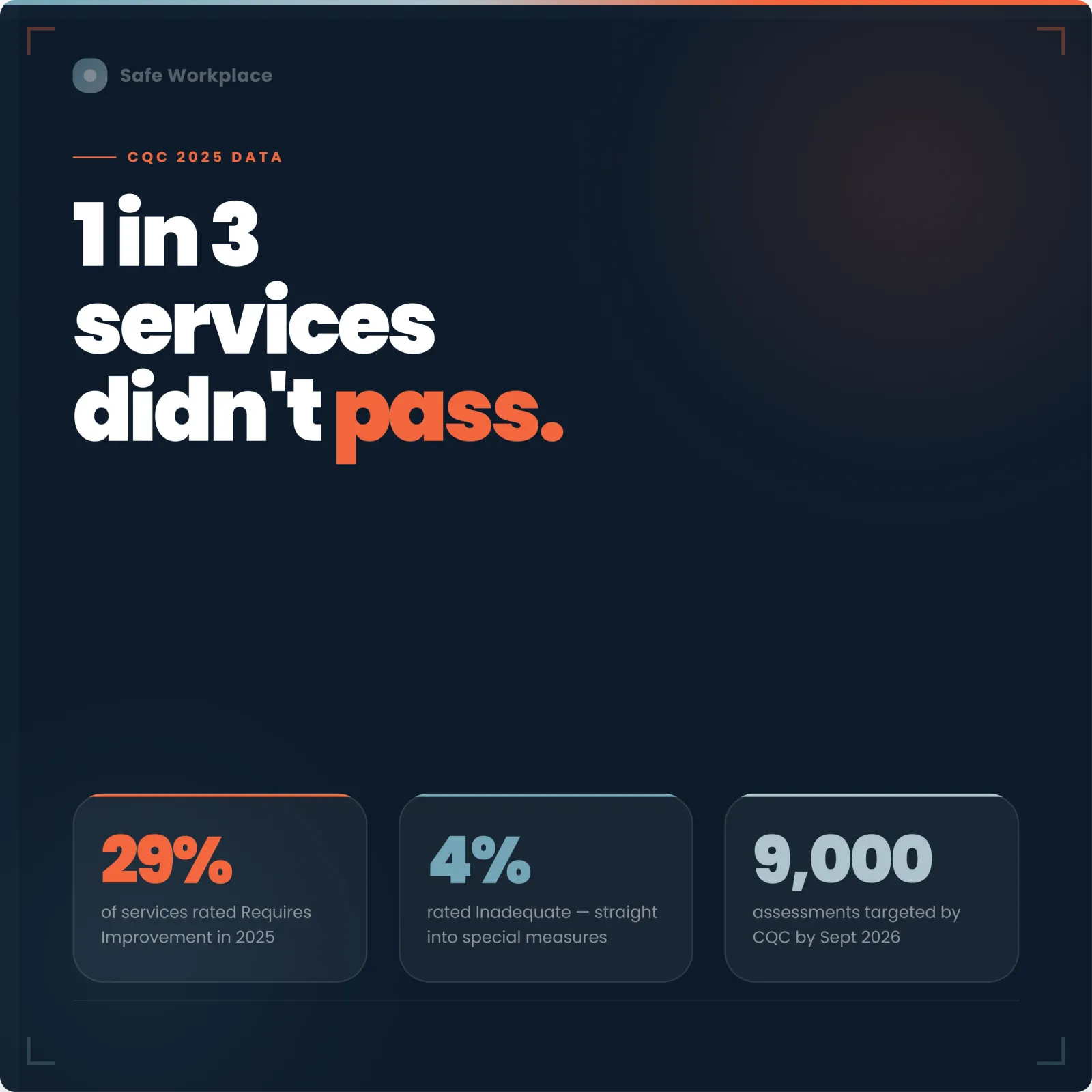
And this is where the ageing-rating queue matters more than the reform. CQC has committed to publishing at least 9,000 assessments across all sectors by September 2026 and says it remains on track. If you are in that queue, your next assessment is likely to come under the framework in force today — not the one everyone is writing about.
Our guide to which services CQC will assess next sets out the per-sector triggers. The short version: over 6 years old in adult social care, over 7 in primary care and community, and in mental health it depends on the rating you hold.
What actually changes for a rating
Three things, none of which touch the rating you currently hold.
How the judgement is reached
Today, evidence is scored, scores build to quality statements, quality statements build to key questions, and key questions produce the rating. The draft frameworks remove scoring and make rating judgements directly at key question level, supported by rating characteristics — published descriptions of what each rating level looks like in your sector.
What the judgement is made against
The 34 quality statements become sector-specific topics framed as key lines of enquiry. Some are unchanged, some renamed, some merged. In adult social care, one disappears entirely.
The four rating levels themselves
Outstanding, Good, Requires Improvement and Inadequate are not changing. What changes is how a service arrives at one.
Does an old rating still mean anything?
Legally, yes — it is your published rating until replaced. Practically, an ageing rating carries two problems that have nothing to do with the reform.
- It puts you in the queue. Age is the dominant prioritisation trigger. A six-year-old Good is not a shield; it is a flag.
- It persuades less. Commissioners, insurers and families read a rating alongside its date. A 2019 Good next to a 2025 Good does not read the same way, whatever the letter says.
What to do in the meantime
- Work out where you sit in the queue first. Check the publication date of your current rating on your CQC profile — not the inspection date, not what you remember. That single fact determines which framework you should be preparing against.
- If you are near a trigger, prepare against the current framework. Our plain-English SAF guide covers how it works today, and the free care home audit tool lists every quality statement with what to check.
- If your rating is recent, read the drafts. Your next assessment probably will use a new framework. Start with the framework changes guide and the crosswalk tool.
- Either way, do not rebuild your evidence library. The drafts are drafts. What is worth doing now is knowing which of your evidence maps to a topic that is merging or disappearing.
- If you hold a poor rating, the clock is shorter. Recovery timescales run on their own track — see what to do after a Requires Improvement or Inadequate rating.
Frequently asked questions
Will my CQC rating expire when the new frameworks come in?
No. A published rating stands until CQC next assesses the service and publishes a new one. Changing assessment methodology does not expire or convert existing ratings.
Will CQC re-rate everyone under the new frameworks?
There is nothing in the drafts to suggest a bulk re-rating exercise. Services are re-assessed through the normal prioritised programme.
Which framework will my next assessment use?
The Single Assessment Framework if the assessment happens before implementation, which is expected at the end of 2026; your sector's new framework after that. If your rating is ageing you are more likely to be assessed under the current framework.
Is an old Good rating a problem?
Not legally, but age is the main trigger CQC prioritises by, and an old rating is less persuasive to commissioners and families than a recent one.
Are the ratings themselves changing?
No. Outstanding, Good, Requires Improvement and Inadequate remain. How a service reaches one changes — scoring is removed and judgements are made at key question level against rating characteristics.
Related: which services get assessed next · how CQC ratings work today · what the CQC is and how it regulates
Sources: CQC, our March update; CQC, priorities for delivering more assessments and tackling aged ratings (May 2026); CQC, levels of ratings. Last reviewed: 30 July 2026.