
CQC is working through an assessment backlog and has published the criteria it prioritises by. The strongest single trigger is an ageing rating — over six years old in adult social care, over seven in primary care and community. If that describes your service, you are near the front of the queue, and the framework reform is a less urgent problem for you than the visit itself.
Why this matters more than the framework change
Most CQC coverage right now is about the four draft frameworks arriving at the end of 2026. That is real, and we cover it in the pillar guide to what is changing in 2026–27.
But for a large number of providers it is the wrong thing to worry about first. If your rating is six or seven years old, you are likely to be assessed under the current Single Assessment Framework, before the new ones land. Preparing for a framework that will not apply to your next assessment is a common and expensive mistake.
The numbers behind the push
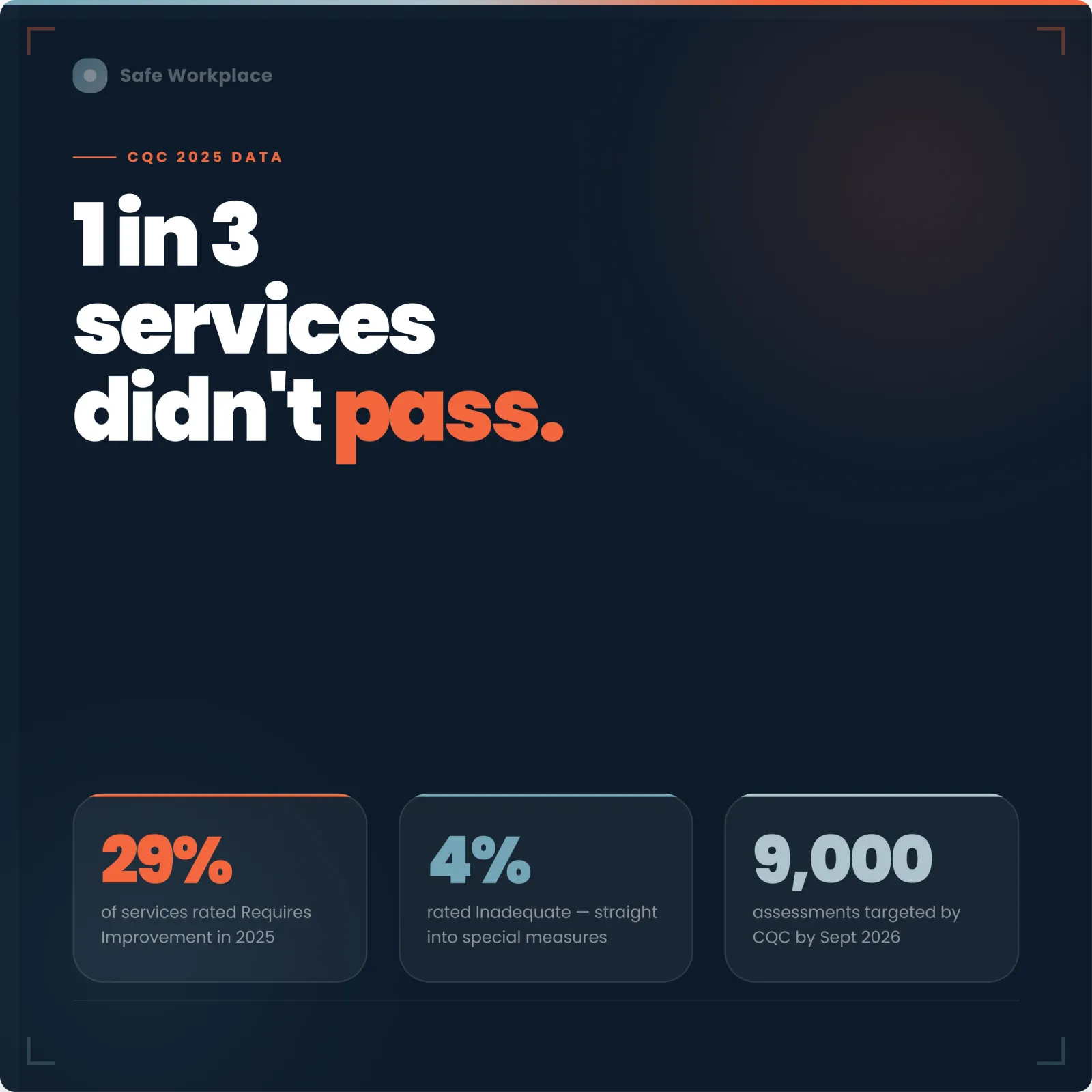
CQC has committed to publishing reports for at least 9,000 assessments across all sectors by September 2026, and says it remains on track. As of its December 2025 update, 4,308 had been published against that target, and the stuck-assessment backlog had been cut from around 500 reports to four.
Two things follow. The volume of assessment activity is materially higher than it has been. And CQC is being explicit about how it chooses — which means you can work out where you stand instead of guessing.
The per-sector triggers
From CQC's May 2026 update on delivering more assessments and tackling aged ratings:
| Sector | What puts you near the front of the queue |
|---|---|
| Adult social care | Ratings over 6 years old; services registered over a year and never assessed; never-assessed services the data flags as very high risk. |
| Mental health | Inadequate not assessed for over 12 months; outstanding over 8 years; requires improvement over 3 years; good over 5 years. |
| Primary care & community | Ratings older than 7 years; services registered a year or more and not yet assessed. |
| Hospitals & specialist | Never-assessed services, by time since registration; increased focus on the independent sector. |
The mental health row rewards a close read. It is the only sector where the trigger depends on which rating you hold, and the intervals are not intuitive: an outstanding service can go eight years, a requires improvement service only three. A service that improved from requires improvement to good has moved from a three-year clock to a five-year one.
How to work out if you are in scope
Three questions, in order:
- What is the publication date of your current rating? Not the inspection date, not the date you were told — the date the report was published on CQC's website. Look it up on your own profile rather than from memory.
- Which sector will assess you? If you hold more than one registration, you may sit in more than one queue on different clocks.
- Have you been registered over a year without ever being assessed? This is a separate trigger from the ageing one, and it catches newer providers who assume they are not on the radar.
If any answer puts you in scope, plan on the basis that assessment could come inside the current framework — not the new one.
What to do if you are in the queue
- Prepare against the framework in force today. The Single Assessment Framework, its five key questions and 34 quality statements. Our plain-English guide to the SAF covers how it actually works, and the free care home audit tool lists every quality statement with what to check.
- Assume less notice than you would like. Higher assessment volume means less slack in the system.
- Fix the evidence you cannot produce on the day. The recurring failure at assessment is not absent improvement; it is improvement that cannot be evidenced quickly. Our guide to what to do after a poor rating covers the evidence thread inspectors look for.
- Run a mock assessment against the areas where your evidence is weakest, not the ones you are confident about. See how to run a CQC mock inspection.
- Do not rebuild your evidence library around the draft frameworks yet. They are drafts, in pilot, and they are unlikely to govern your next assessment if you are in this queue.
The one case where both matter
If your rating is recent and you are not near a trigger, the calculation reverses: your next assessment probably will be under a new framework, and the reform is the thing to plan for. In that case start with the framework changes guide and our free crosswalk tool, which maps all 34 current quality statements onto the four draft frameworks.
Frequently asked questions
How does CQC decide which services to assess next?
It publishes prioritisation criteria. The dominant factor is an ageing rating, with sector-specific thresholds, alongside services registered for over a year that have never been assessed and risk signals in the data.
How old does a rating have to be before CQC prioritises it?
Over 6 years in adult social care and over 7 in primary care and community. Mental health varies by rating held: 12 months for inadequate, 3 years for requires improvement, 5 for good and 8 for outstanding.
Will my next assessment use the new frameworks?
If you are in the ageing-rating queue, probably not — the draft frameworks are in pilot over summer 2026 with implementation expected at the end of the year, so an assessment before then would use the Single Assessment Framework.
I have never been assessed. Am I at risk?
Being registered for over a year without assessment is itself a prioritisation trigger in adult social care, primary care and community, and hospitals and specialist services.
How many assessments is CQC doing?
CQC has targeted at least 9,000 published assessments across all sectors by September 2026 and reports being on track, with 4,308 published as at its December 2025 update.
Related: what is changing in 2026–27 · rating characteristics explained · what the CQC is and how it regulates
Sources: CQC, priorities for delivering more assessments and tackling aged ratings (May 2026); CQC, December 2025 update; CQC, our March update. Last reviewed: 2 October 2026. We review our CQC pages monthly.