

Understand the Care Quality Commission's role, inspection process, and rating system to ensure your service is always compliant and inspection-ready.
For any healthcare provider in England, the initials CQC are a constant presence. But beyond being the industry regulator, what is the Care Quality Commission's role, and how can you ensure your service not only meets its standards but excels?
Navigating CQC compliance can feel overwhelming, especially when you're juggling patient care, staff management, and endless administrative tasks. This guide breaks down everything you need to know, moving you from a state of reactive stress to proactive confidence.
CQC stands for the Care Quality Commission. It is the independent regulator of health and adult social care in England, established under the Health and Social Care Act 2008. In everyday use in the care sector, “CQC” refers to three different things: the organisation itself, the inspection it carries out, and the rating that inspection produces — “we’ve got our CQC coming up”, “we’re CQC registered”, “we’re CQC Good”.
CQC regulates providers in England only. The equivalent bodies are the Care Inspectorate in Scotland, Care Inspectorate Wales, and the RQIA in Northern Ireland.
What is the CQC, and What is its Role?
The Care Quality Commission (CQC) is the independent regulator of health and adult social care in England. Think of it as the national watchdog responsible for making sure that the care provided to people is safe, effective, compassionate, and high-quality.
Its primary mission is to protect the public and hold providers accountable. It operates with legal authority, meaning its findings and requirements have significant weight for any healthcare organisation.
CQC Core Functions: Register, Monitor, and Rate
Source: CQC, how we assess providers and registration guidance.
The CQC's work can be broken down into four key areas:
Registration: No health or social care provider can legally operate in England without being registered with the CQC. This process ensures a service meets a fundamental set of safety and quality requirements from day one.
Monitoring & Inspection: The CQC continuously monitors services through data collection, feedback from the public, and on-site inspections. This is where being inspection-ready at all times is crucial. Modern regulatory tracking tools can help you stay ahead of changing requirements, so you're never caught off guard.
Enforcement: If a service fails to meet the required standards, the CQC has the power to take action. This can range from issuing warning notices to prosecution in the most serious cases.
Public Information: The CQC publishes its inspection reports and ratings, giving the public clear, accessible information to help them choose their care provider with confidence.
Who Does the CQC Regulate?
The CQC's scope is broad, covering the majority of health and social care services in England. This includes:
Hospitals (both NHS and independent)
GP surgeries and clinics
Dental practices
Care homes and nursing homes
Ambulance services
Community-based services like home-care agencies
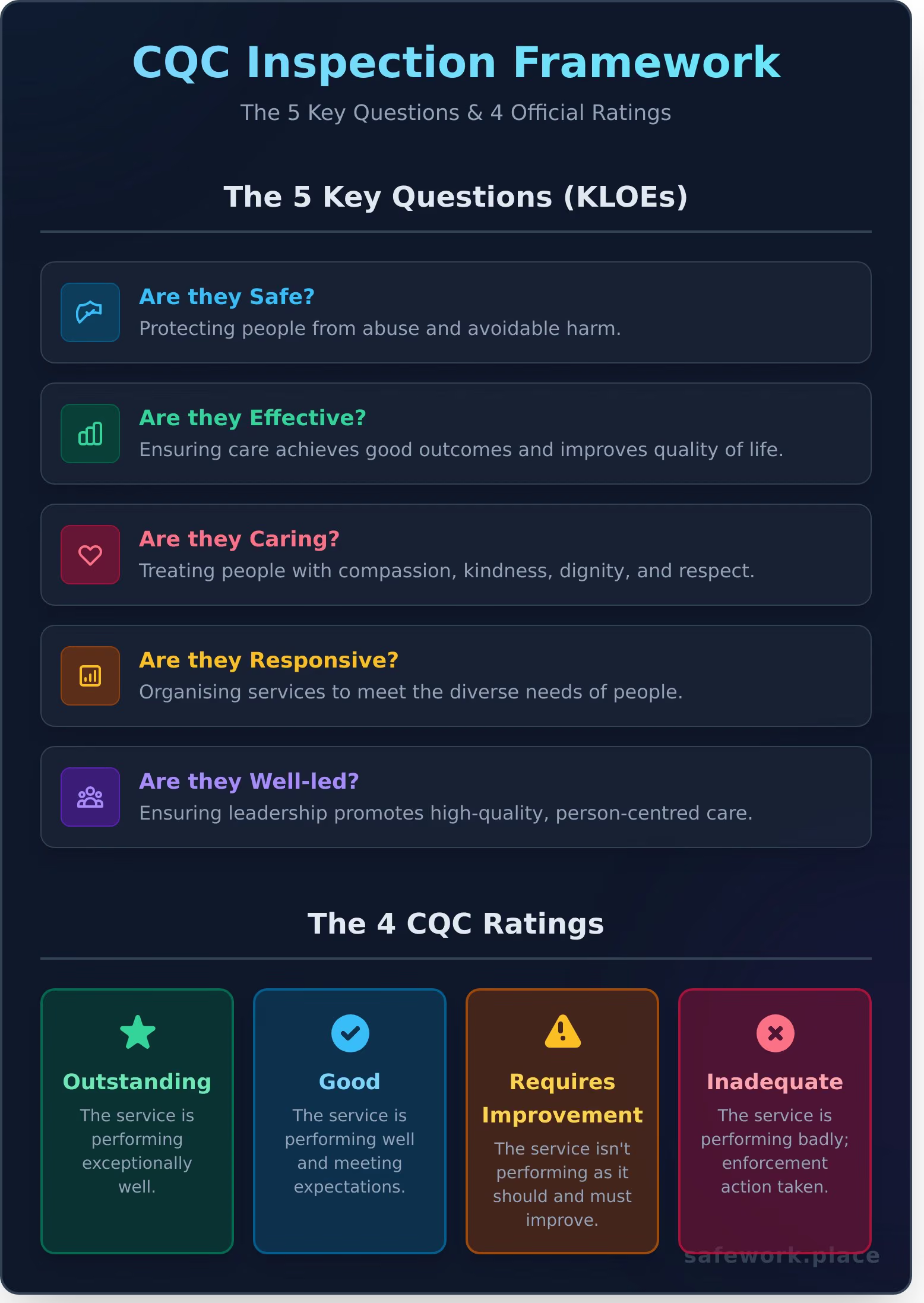
The CQC Inspection Process and Ratings Explained
The thought of a CQC inspection can be daunting, but understanding the process is the first step to feeling prepared. The goal of an inspection isn't to catch you out; it's to assess how your service delivers care against a consistent set of standards.
Inspections can be comprehensive (covering the entire service) or focused (looking at a specific issue). They can be planned in advance or responsive, triggered by a concern. During an inspection, the CQC team will gather evidence by observing care, speaking with patients and staff, and reviewing your records and documentation.
The five key questions
Source: CQC, the five key questions we ask.
To structure their assessment, CQC inspectors ask five core questions about your service. These five have survived every framework change since 2014 — they are the stable layer under all the vocabulary churn, and being able to evidence each is what a successful inspection actually turns on.
A note on terminology, because it changes and the internet has not caught up. Until 2023 these five questions were broken down into key lines of enquiry (KLOEs). In 2023 the Single Assessment Framework replaced KLOEs with 34 quality statements. Under the reform announced in 2026, quality statements are being replaced in turn by key lines of enquiry framed as structured questions — so KLOEs are, in effect, coming back. The five key questions below have not moved throughout. See our full explainer on KLOEs and why they are returning, or the guide to the new assessment frameworks for what changes and when.
Are they Safe? This is about protecting people from abuse and avoidable harm. Inspectors will look at everything from safeguarding procedures and medicine management to your incident reporting culture.
Are they Effective? Does your care, treatment, and support help people achieve good outcomes and maintain a good quality of life? This KLOE examines how you use evidence-based guidance and ensure your staff have the necessary skills and knowledge, often demonstrated through robust training records.
Are they Caring? This explores how your team involves people in their care and treats them with compassion, kindness, dignity, and respect.
Are they Responsive? How well are your services organised to meet people’s needs? This looks at person-centred care, care planning, and how you handle complaints.
Are they Well-led? Is there strong leadership and governance that promotes a high-quality, person-centred culture? This is where having clear, accessible policies and procedures, managed through a central policy management system, becomes critical evidence.
Each of the five is examined in far more detail than a summary allows. For the full picture — including what replaces the 34 quality statements, sector by sector — see our guide to CQC’s new assessment frameworks, or use the free CQC framework crosswalk tool to see exactly where each quality statement lands in your sector.
Understanding the Four CQC Ratings
Source: CQC, levels of ratings.
After an inspection, your service receives an overall rating, plus a rating against each of the five key questions. This system makes it easy for the public to compare providers — and it is the number most people will ever see about your service. For what each rating means in practice and how to move up from one, see CQC ratings explained.
Rating | Description |
|---|---|
Outstanding | Your service is performing exceptionally well and providing innovative, high-quality care. |
Good | Your service is performing well and meeting the CQC's expectations. This is the standard people should expect. |
Requires Improvement | Your service is not performing as well as it should. The CQC will specify what actions you must take. |
Inadequate | Your service is performing badly. The CQC has taken enforcement action against the provider. |
How to Achieve and Maintain CQC Compliance
Achieving a 'Good' or 'Outstanding' rating isn't about scrambling before an inspection; it's about building a culture of continuous compliance. The biggest challenge for many providers is shifting from reactive problem-solving to proactive quality management.
This means moving beyond simply ticking boxes and embedding robust systems for governance, risk management, and learning from incidents into your daily operations.
(Ready to get started? Check out our practical tips on How to Prepare for a CQC Inspection)
Common Compliance Challenges for Providers
Does this sound familiar? Many healthcare managers feel overwhelmed by the same recurring issues:
Disconnected Systems: Juggling scattered spreadsheets, paper records, and different software for different tasks, making it impossible to see the full picture.
Lack of Visibility: No real-time insight into risks, incidents, or audit outcomes, meaning problems aren't spotted until it's too late.
Inconsistent Processes: Different teams or sites follow different procedures, leading to gaps in compliance and quality.
The Evidence Scramble: When an inspector arrives, pulling together the necessary documents, reports, and data is a manual, time-consuming nightmare.
Streamline Compliance with a Unified Platform
Instead of fighting fires with outdated tools, you can embed compliance into everything you do. A unified platform like Safe Workplace removes the guesswork and administrative burden, allowing you to focus on delivering excellent care.
Centralise Your Data: Bring all your quality, risk, and compliance information into one secure place. No more hunting through spreadsheets or filing cabinets for evidence.
Automate Audits & Actions: Schedule and manage your audits digitally. Link findings directly to the KLOEs and track corrective actions to completion, giving inspectors a clear, auditable trail.
Strengthen Governance: Manage policies, track staff training, and monitor regulatory changes automatically. Demonstrate that your service is truly well-led.
Stay Inspection-Ready, Always: With real-time dashboards and instant reporting, you can see exactly where you stand against CQC standards at any moment, giving you the clarity and confidence to welcome any inspection.
Remove the guesswork from CQC compliance. See how CompliantCare helps →
What CQC means in health and social care specifically
The phrase “CQC” carries a slightly different weight depending on where you work, which is why the same three letters mean different things to different people:
In adult social care — care homes, nursing homes and domiciliary agencies — CQC is the body that decides whether you can operate at all, and the rating is a commercial fact. Local authority framework places and private enquiries both hinge on it.
In primary care — GP practices, dental practices, out-of-hours — CQC registration sits alongside NHS contractual obligations, and the two are assessed separately.
In hospitals and mental health services, CQC assessment runs alongside NHS oversight, and for mental health there is the additional Mental Health Act monitoring function.
For staff, CQC usually means the inspection: the week the files get checked and everyone is asked whether they feel able to raise a concern.
The standards themselves are consistent across all of them. What differs is the evidence expected and, from 2026, the framework applied — CQC is moving from one framework to four sector-specific ones. Our guide covers what changes for each sector.
CQC registration and your certificate
Source: CQC, registration guidance for providers.
You cannot legally provide a regulated activity in England without being registered with CQC. Registration is granted to a provider (the legal entity) and, for most services, requires a registered manager — a named individual who has themselves been assessed as fit.
Once registered, you receive a certificate of registration listing the regulated activities you are permitted to carry on and the locations you may carry them on from. You must display it. It is not a quality mark and it is not a rating — it means you are lawfully allowed to operate, nothing more. Your registration details are also published on CQC’s public register, which is where funders and families will check you.
If your activities or locations change, your registration has to change with them. Operating outside the terms of your registration is an offence, not an administrative oversight.
Frequently Asked Questions (FAQs)
What does CQC stand for? CQC stands for the Care Quality Commission. It is the independent regulator of all health and social care services in England.
How often does the CQC carry out inspections? The frequency of inspections depends on the service's previous rating and any new information the CQC receives. Services rated 'Outstanding' are inspected less frequently than those rated 'Inadequate'. However, the CQC can inspect any service at any time if concerns are raised.
What are the CQC's Fundamental Standards of Care? These are the minimum standards of care that a provider must meet. They cover essential aspects like person-centred care, dignity and respect, safety, safeguarding, and good governance. Failure to meet these standards can result in enforcement action.
What happens if a healthcare provider gets an 'Inadequate' CQC rating? An 'Inadequate' rating is serious. The CQC will place the provider in special measures, requiring them to make rapid and significant improvements. The CQC will re-inspect within six months, and if sufficient progress isn't made, it can lead to the cancellation of the provider's registration, effectively closing the service.
Can you challenge a CQC inspection report? Yes, providers have the opportunity to check the factual accuracy and completeness of the draft inspection report before it is published. If you disagree with the ratings, there is a formal process for a ratings review.
Is CQC compliance a legal requirement in the UK? Yes, for health and adult social care providers in England, registration with the CQC and adherence to its regulations is a legal requirement under the Health and Social Care Act 2008.
What does “CQC safe” mean? “Safe” is one of the five key questions CQC rates you against. It asks whether people are protected from abuse and avoidable harm — covering safeguarding, medicines management, staffing levels, premises, infection control and, critically, whether your staff report incidents and see something happen as a result. A service can be Good overall and still be rated Requires Improvement on Safe, and that is the rating commissioners look at hardest.
Does CQC cover Scotland, Wales or Northern Ireland? No. CQC regulates England only. Scotland has the Care Inspectorate, Wales has Care Inspectorate Wales, and Northern Ireland has the RQIA. The standards and the language differ, so English CQC guidance does not transfer directly.
What are CQC quality statements, and are they being replaced? The 34 quality statements were introduced with the Single Assessment Framework in 2023, replacing the previous key lines of enquiry. Under the reform announced in 2026 they are being replaced in turn by key lines of enquiry framed as structured questions, within four sector-specific frameworks. The frameworks are currently in draft and CQC’s instruction is to keep following existing published guidance until implementation. Our free crosswalk tool maps all 34 to what replaces them, by sector.
Is CQC still scoring evidence? Not at evidence-category level. CQC stopped scoring at that level on 6 December 2024, and the 2026 reform removes scoring altogether, with rating judgements made directly at key question level against published rating characteristics. We have written about why that raises the value of your evidence rather than lowering it.
Book a demo and see how CompliantCare simplifies CQC compliance →
Keep reading
CQC’s new assessment frameworks — what is changing in 2026–27, and when
CQC KLOEs — what key lines of enquiry were, and why they are coming back
CQC notifications — what you must report, when, and under which regulation
CQC fundamental standards — all 15, Regulations 8 to 20A, and which can be prosecuted
CQC framework crosswalk tool — free: where each of the 34 quality statements lands in your sector
CQC inspection checklist — how to prepare, question by question
CQC ratings explained — what each rating means and how to move up
AI-Powered Compliance Automation
Unified Platform for Quality, Risk & Audits
Trusted by UK Healthcare Providers
Related reading
Sources
Everything on this page is taken from CQC's own published guidance. Where our reading differs from theirs, theirs is correct.
- CQC — How we assess providers
- CQC — The assessment framework
- CQC — The five key questions we ask
- CQC — Levels of ratings
- CQC — Registration guidance for providers
- CQC — Notifications
- The Health and Social Care Act 2008 (Regulated Activities) Regulations 2014
- CQC — State of Care 2024/25
Last reviewed: 2 October 2026. We review this page monthly against CQC's published guidance.